

For as long as I can remember, Gen Z has been dubbed the “vape generation” and rightfully so. As a freshman in college in 2016, it was Juul’s world and we were all just living in it. I would see people hitting it in between class, secretly in class, at parties, while waiting for the stoplight to turn green, every possible waking moment. Fun flavors? No tar? No secondhand smoke? Music to our teenage ears. Flash forward to ~2019 and vaping culture became cringe – a viral video came out of people hitting USBs at the club thinking they were vapes, and we decided then and there that vaping was embarrassing. Not to mention research and information coming out that the health claims of vapes turned out to be false advertising, with the FDA issuing a marketing denial order that forced Juul to temporarily stop selling and distributing its e-cigarette devices and pods in 2022. The vape was no longer cool, and no longer “better for you” than cigarettes, but Gen Z has simply moved on to other forms of nicotine: cigarettes all the way to Zyns.
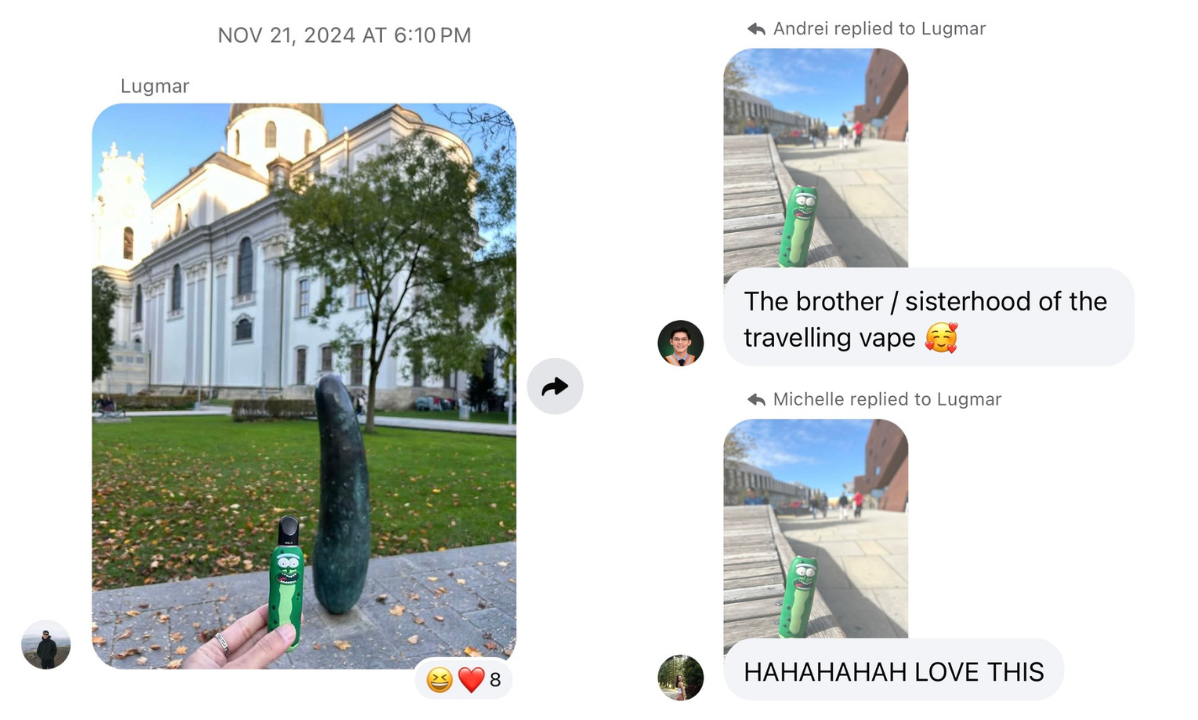
In 2024, my friend group had a sisterhood of the traveling vape whom we called “Pickle Rick” that we shared during our first group trip and who has since been passed around the world. Today, we have the latest iteration of nicotine, Zyns, and the unmistakable imprint of Zyn pouches we now see everywhere.
The story of Gen Z and nicotine is really about the uncomfortable gap between what we know, what we value, and what we choose – and how that contradiction has become an inevitable part of being a consumer today.
“It was remarkably easy to acquire/use discreetly. If you went to a high school in the late 2010s, at least a few of your classmates were vaping in the bathrooms, so you didn't even have to necessarily own a vaping device to do it. For that matter, because we were exposed to it fairly young, it was pretty easy to fall for it. We're talking middle-school aged kids here. We weren't thinking logically.”
– Liz (2002)
Informed Self-Destruction
Our research today shows that a majority (55%) of Gen Z respondents have some history of nicotine use with 25% who are still users today. This is a shocking number: according to the CDC, between 2010 and 2015, adult smoking rates dropped drastically from roughly 21% to 15.1% with youth smoking reaching record lows. Then the vape came out, and the rest is history. Our respondents reported that the average age they started vaping was 18 years old, but for some it started as early as 10 years old. The anti-smoking campaigns that got the Millennials unfortunately did not reach Gen Zs – this education gap coupled with false claims and advertising that vapes were “better than cigarettes” was all it took for young, impressionable Gen Zs to get hooked.
While friends and social exposure was the main gateway, the motivation for continuing usage was more functional: it provided connection, stress relief, stimulation, ritual, fun, and identity. As Jason (2004) says, “I feel that nicotine brands portray a false sense of comfort and a source of safe relaxation that appeals to Gen Z. There’s so much pressure and anxiety in everyday life now, that it can feel almost like self-care to indulge in something like this.”
When looking at Gen Z’s current perception of nicotine, we found that 46% of Gen Z respondents view nicotine use as nasty, unhealthy, and cringe, while 54% view it as normalized, trendy, and aesthetic. Conversely, we’re seeing perception proportionally flipped online, with nicotine use being portrayed as slightly more negative than cool. Gen Z simultaneously perceives nicotine as unhealthy & normalized, uncool & desirable; they aren’t mutually exclusive. At a time where Gen Zs face increasing financial pressure, a poor economic environment, and increased costs of living, smoking becomes a natural coping mechanism.
“Everyone is aware that it's bad, but so is all drug use. It's more like informed self destruction.”
– Ana (2003)
The Nicotine Catch-22
The vape’s demise was cigarette’s win. In 2026, the cigarette has become cool again – it’s glamorized on social media, seen on every other celebrity and influencer, and was actually the form of nicotine that was most used by our Gen Z respondents. Despite this, we found that 74% of our Gen Z nicotine users have wanted to quit at some point; among those, about 51% were successful. While some were more successful than others, it’s clear that Gen Zs at the very least don’t want to be dubbed the “vape generation.” But some of us, inevitably, still choose it.
“My friends who vape or use nicotine know it’s unhealthy, expensive, environmentally harmful, cringe, and disgusting, but they still do it. My guess is that if we want to decrease people’s substance use, including nicotine, our society needs to invest in decreasing things that stress people out and lead them to start using substances to soothe (like increasing wages, making it easier to find housing, decreasing food costs, improving public education and decreasing costs of higher education so people can have greater economic mobility).”
– Emily (1999)
Between the choice of vaping at the expense of our physical health versus not vaping at the expense of our mental health, both choices seem to be a lose-lose. Gen Z's relationship with nicotine is less like a single bad decision and more like a never-ending game of choosing the lesser evil. We switch products, find new justifications, try to quit, and sometimes come back. The form of nicotine changes, but the underlying need doesn't.
“No one really lectures people for smoking anymore, nor do they think someone's a square for not smoking.”
– Asimov (2006)
The Cost Of Choice
The story of Gen Z and nicotine isn't really about ignorance anymore. We know what we're putting into our bodies. We know the risks. We know the alternatives. And yet, knowing better doesn't always mean choosing better. We’ve learned that consumption always comes with a trade-off: health for relief, values for convenience, sustainability for affordability, belonging for individuality. Every choice comes with a cost, and Gen Z is increasingly conscious of what we're willing to pay. For brands, that means the old playbook of telling Gen Z what they should care about is becoming less effective. We don't need another brand to tell us what's good, ethical, sustainable, or healthy. We're already aware of the contradictions. What we want is honesty about the trade-offs. Tell us what your product gives us. Tell us what it costs us. Don't disguise the compromise or pretend your brand exists outside of it. Then let us decide whether the trade-off is worth it.

.png)
.png)

.png)
.png)
.png)
.png)

